I often get asked a sharp question: what is a channel drain, and could a simple trench keep heavy Metro Atlanta rains from ruining a garage or basement?
I run Drainage First and we have served Atlanta for over 20 years. We handle service calls ourselves and give same-day, written estimates. Our goal is clear: fix the root cause of runoff by improving exterior grading and surface routing, not by pushing costly interior systems.
The basic idea is simple. A trench or linear unit captures sheet-flow from pavements and routes water to an outlet. That can stop pools from pushing toward slabs, garages, and foundation walls.
In this guide I’ll show plain-language checks you can do at home, plus when to call us for layout and sizing. We’ll cover parts, materials, load ratings, and long-term care so your system lasts.
Call us at (678) 389-9544 or email carter@drainagefirst.com to discuss solutions for your Atlanta property and stop flooding before it starts.
Key Takeaways
- Simple surface control often prevents basement moisture.
- Trench/linear units handle sheet-flow on hardscapes.
- We give same-day written estimates in Metro Atlanta.
- Call (678) 389-9544 or email carter@drainagefirst.com for help.
- Exterior grading matters more than interior fixes.
Understanding Surface Water Drainage on Hardscapes
Rain over hard pavement doesn’t vanish — it runs until something stops it. On driveways, patios, and walkways, rain becomes sheet-flow that follows slope and edges. That flow finds low spots and often pools where it can harm thresholds and foundations.
Common patterns we see in Metro Atlanta include driveway-to-garage movement, patio depressions near doors, and walkways that push water toward walls. These simple patterns point to surface fixes first. Regrading or adding a short interceptor usually solves the problem before it reaches below-grade areas.
- Area drains work when you can create one central low spot for collection.
- Channel drains perform best for wide-sheet runoff where regrading to one point is impractical.
- Tie any surface capture into a broader drainage system so collected water goes away, not to another problem spot.
I design common-sense exterior drainage and grading solutions that stop water at the surface. That approach protects basements and cuts the need for costly interior systems.
What is a channel drain and when do you need one?
Homeowners call me when water keeps finding the same weak spot at a garage or patio edge. I explain that a channel drain system is a long, narrow trench with a grate that captures lineal sheet flow and sends it to an outlet instead of relying on one point.
Common applications and problem spots
- Garage thresholds — intercepts driveway runoff before it hits the slab.
- Bottom of sloped driveways, pool decks, patios, and small parking pads.
- Sites with shallow soil or bedrock where deep pipe trenches become costly.
How to tell if you need one
Look for repeated puddles, staining at thresholds, or clear runoff tracks toward the house. Those signs show surface control is needed first.
At Drainage First, with 20+ years in Metro Atlanta, I focus on exterior fixes that protect foundations. For many yards, trench drains give the right performance without deep pipe runs.
How Channel Drains Work to Control Water Flow
Gravity runs the job; our task is to give water an easy, safe route away from structures.
Capturing surface water at the lowest point and moving it to an outlet
Placement matters. Water on hard surfaces always finds the lowest point. A channel drain sits where runoff naturally concentrates and collects water along its length.
The channel transports that flow toward an outlet. From there the water enters a larger drainage system and leaves the site instead of pooling near foundations.
How the grate controls debris while allowing drainage
The grate does three jobs: it lets water in, blocks large debris, and protects the channel from traffic damage.
Choose the right grate for the load and you cut cleaning time. Most clogs come from poor grate selection or skipped maintenance, not from a failed system.
Do channel drains need slope, or can they be installed level?
They can work level if the outlet sits at the base, but a slight fall helps performance.
- Recommended fall: ~5mm per 1m when possible.
- Outlet location matters most during heavy rain to prevent backup.
- Regular inspection keeps debris from reducing flow.
Outcome: Properly placed and maintained drains give controlled surface drainage, fewer puddles, and less pressure on below-grade walls.
Key Parts of a Channel Drain System
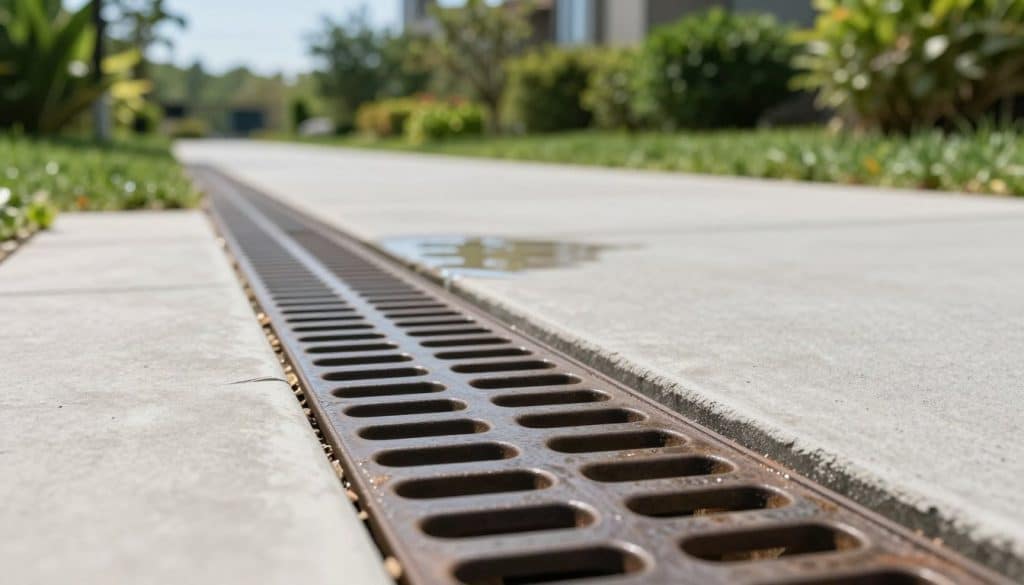
Every successful surface system starts with the parts that make the whole work. I map each component so homeowners know what they buy, not just a single line item.
Channel body options matter. Choose concrete for heavy driveways, metal for high loads, and plastic for light residential patios. Each material affects handling and longevity.
- Grate choice affects safety and flow. Pick patterns that keep debris out and suit pedestrian or vehicle loads.
- End caps, junctions, and bends let you customize layout. Small parts determine ease of future maintenance.
- Outlet types — end outlet or bottom outlet — influence cover depth and gravity flow to the pipe.
- Pipe tie-ins link the unit to a broader drainage system; slope and diameter must match expected flow.
- Trash boxes and sediment buckets catch leaves and grit before the pipe, protecting downstream components.
In practice, I design systems that are simple to maintain. A well-picked grate and an easy-clean sediment box keep flows clear and reduce service calls.
Types of Channel Drains and Best-Fit Applications
Choosing the right linear system starts with matching form to function on your property. I break decisions into two clear groups and then match material to expected use.
Slot systems versus grated systems
Slot systems offer low visual impact and heel-safe surfaces. They work well on patios and front entries where looks matter. Expect lower peak flow and more care with heavy runoff.
Grated systems handle higher flow and easier debris access. They fit driveways, walkways, and parking areas where cleaning and capacity matter most.
Material choices and tradeoffs
- Plastic — light, cost-effective for small patios and pedestrian zones.
- Polymer concrete — durable, chemical resistant, good for medium loads.
- Steel — strong and tidy for high-end entries and moderate traffic.
- Concrete — best for heavy driveways, parking, and lots that see regular vehicle loads.
Matching type to applications
For patios pick slot or plastic for subtlety and low loads. For driveways choose grated units in polymer or concrete to resist rolling loads. Walkways can use either, based on debris and aesthetics. For small parking pads or lots prioritize strength and grate rating.
Final choice: match the system type, material, and expected load. I recommend choosing for real-site conditions and maintenance tolerance. That keeps your drainage performing and reduces future service calls.
Sizing a Channel Drain for Your Area and Rainfall
Sizing gets the job right the first time and saves you from costly fixes after the next storm.
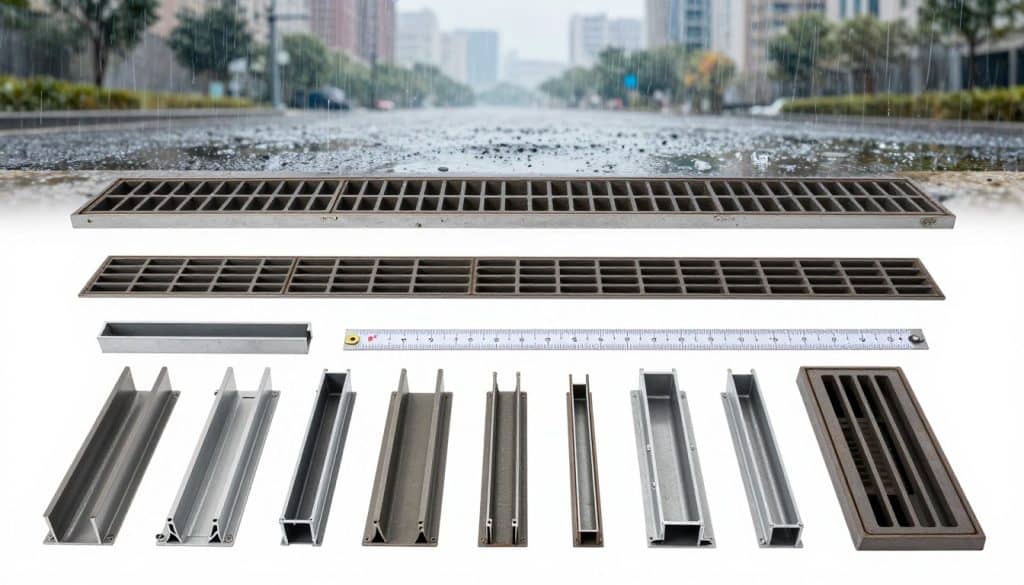
Start by estimating runoff: measure the drainage area, check local rainfall intensity, and pick a runoff coefficient for the surface. Hard surfaces like concrete and asphalt shed nearly all rain. Landscaped areas shed far less.
Translating runoff into channel performance
Use simple math: calculate total flow (Q) from area × intensity × coefficient. Divide Q by channel length to get GPM per foot. That tells you how much flow each foot of linear unit must handle.
Rule-of-thumb widths and pipe checks
- Driveways: many residential projects use 4–5″ channel widths for driveways.
- Patios/pool decks: 2–3″ widths often work for pedestrian areas.
- Outlet pipe: a 4″ smooth interior pipe often suffices. Use 6″ when corrugated pipe or long runs reduce capacity.
Field note: the outlet must match the channel capacity. An undersized pipe turns your channel into an overflowing gutter. Size it right once and you cut future service calls.
Choosing the Right Grate and Load Rating
Choosing the right grate starts with how people use the space day to day. I explain load types in plain terms so you pick the right part for each area.
Load types homeowners see:
- Pedestrian — foot traffic on walkways and patios.
- Static — parked vehicles on driveways or parking areas.
- Rolling — cars driving over the unit, common at garage entries and parking lots.
The key rule: the system adopts the lowest-rated component. Often the grate sets the overall load rating. Pick a grate rated for real use, not just looks.
Grate materials and safety
Choices include cast iron, ductile iron, stainless, galvanized steel, plastic, and decorative finishes. Concrete or heavy metal works best for parking and rolling loads. Slot designs offer heel-safe surfaces for entries and entertaining areas.
Maintenance trade-offs: tighter openings reduce debris entry but need more surface sweeping. Larger slots pass more water but may trap leaves in the channel.
I match grate choice to applications so you avoid early failure and reduce service calls. If you’d like, I’ll review your site and recommend the proper rating and material for each area.
Channel Drain Installation Basics for Long-Term Performance
Start every project by walking the surface and marking where flow collects. That first check tells me where to place the unit so water never reaches the garage or door threshold.
Layout planning and placement
Identify low points. Confirm runoff direction, mark the intercept line, and plan pipe runs to a safe discharge. Place units at garage entries and other vulnerable areas.

Concrete encasement and pouring best practice
Non-negotiable: set the channel drain in concrete and keep the grate installed during the pour. That prevents warping and preserves alignment.
Tape the grate to protect the finish and make cleanup simple.
Elevation, alignment, and connections
Set the top flush with the finished surface so water enters cleanly. Check straightness; even small waves trap debris and reduce flow.
- Seal end caps and tie into the pipe and drainage system.
- Use concrete around sides and bottom for traffic areas to improve longevity.
- Confirm outlet slope so the unit never backs up during heavy rain.
Final note: product choice matters, but installation quality matters more. Most bad drain complaints come from poor installs, not the parts. If you want a same-day review in Metro Atlanta, I’ll come by and lay out a durable plan.
Conclusion
Finally, choose durable solutions that fix root causes, not symptoms. A properly placed channel drain captures surface water before it reaches thresholds. That simple intercept often stops repeat wet spots and seepage.
Think in systems: the channel drain, outlet, and drainage system must match load, debris expectations, and the site. Correct sizing keeps steady flow during heavy storms and prevents backups.
Keep maintenance simple: quick periodic cleaning of grates and sediment traps keeps drains working. Good upkeep avoids clogs and reduces service calls.
We are locally owned and operated for 20+ years in Metro Atlanta. I handle calls myself and provide same-day written estimates. Call Drainage First at (678) 389-9544 or email carter@drainagefirst.com for straightforward project advice and a site review.