What Does French Drain Look Like? Drainage First Explains

On This Page

Curious whether a simple trench can stop persistent water near your foundation? I ask that because homeowners call me after repeated basement dampness and soggy yards. I’m the owner of Drainage First, locally owned in Metro Atlanta with over 20 years of hands-on experience.

A typical french drain appears in two ways. You may see a visible rock-and-gravel strip that reads like hardscaping. Or the system may be hidden under turf after installation, with only an outlet visible where water leaves the property.

These visuals matter. They tell you if the system is true subsurface drainage or just a shallow ditch that won’t stop basement moisture. We focus on fixing the real cause—grading and exterior routing—before suggesting interior fixes.

Note: drainage work changes how water moves around your home, so planning slope and the outlet comes before digging.

If you want fast, personal help, call (678) 389-9544 or email carter@drainagefirst.com.

Key Takeaways

  • A true french drain is a sloped trench with gravel and a perforated pipe.
  • It can be visible as rock hardscaping or hidden under turf.
  • Visual clues help spot systems that actually redirect water away from the foundation.
  • Exterior drainage and grading often fix basement moisture more cheaply than interior systems.
  • Plan slope and outlet first—safety and home structure matter.
  • Drainage First offers local, same-day written estimates and personal service.

What Does French Drain Look Like in a Yard or Around a Foundation?

I see two common appearances when I inspect Atlanta yards. One is a narrow, intentional strip of washed stone that reads as hardscaping. It functions as a surface channel while moving water away from problem areas.

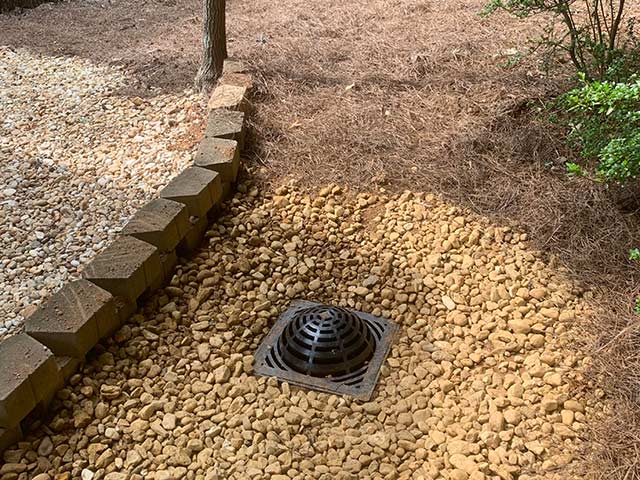
At the top of a run you may find a small inlet grate set at ground level. That inlet marks where surface flow or concentrated runoff enters the trench and into the buried pipe.

The bottom outlet and hidden installs

Follow the trench downhill to find an exposed pipe end or outlet. It’s often visible at the base of a slope or near a wooded edge where water discharges safely.

When covered, a line of slightly greener grass or a subtle settling seam can point to a concealed trench around a foundation. You might also see a cleanout cap if one was left accessible.

Pipeless and landscaping options

  • Rock drainage ditch: a narrow bed of gravel used as a tidy channel that doubles as hardscaping.
  • Pipeless trench: fabric-lined stone that reads like a dry creek bed and blends with landscaping.
  • Tells to check: consistent trench line, clear slope from top to bottom, defined inlet and outlet, and coarse stone sized for fast flow.

We place these systems where they work best in Metro Atlanta: along uphill sides of homes, fence lines that trap runoff, and near down-slope exits that carry water away. If you spot any of these clues, call us for a quick, on-site look and practical advice.
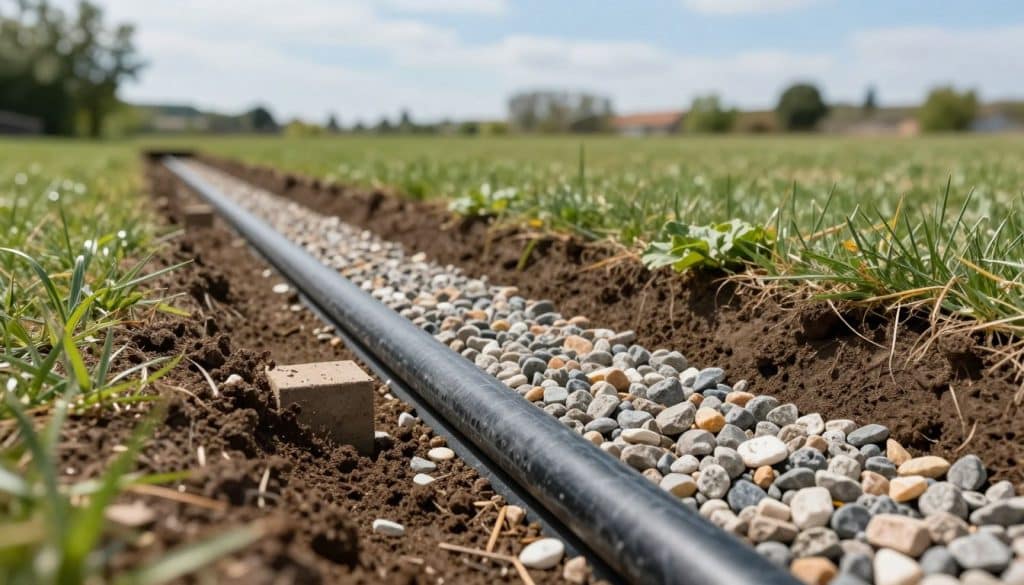
A detailed illustration of a French drain system installed in a residential backyard. In the foreground, display a cross-section of the drain showing the gravel layer, perforated pipe, and soil surrounding it, highlighted with subtle textures and colors. The middle ground features the sloped landscape directing water towards the drain, with patches of grass and small plants. In the background, a clear sky with soft, natural lighting enhances the overall scene, creating a calm and functional atmosphere. Capture the image from a slightly elevated angle to give a comprehensive view of the entire system, focusing on the arrangement and materials used. The landscape should feel serene and functional, emphasizing the practicality of the drainage solution.

The Key Parts of a French Drain System

A reliable drain system depends on a handful of simple elements installed with the right slope. I explain each part so you know what you pay for and why it lasts.

The trench and why slope matters for water flow

The trench is not just a hole. It must slope so water moves downhill without pooling.

That steady path prevents the trench from becoming a soggy pocket that fails over time.

Washed gravel and stone layers

Coarse, washed gravel creates large voids that form the path of least resistance for water.

We use 3/4″ stone so flow stays fast and sediment settles less often.

Perforated pipe options and fabric

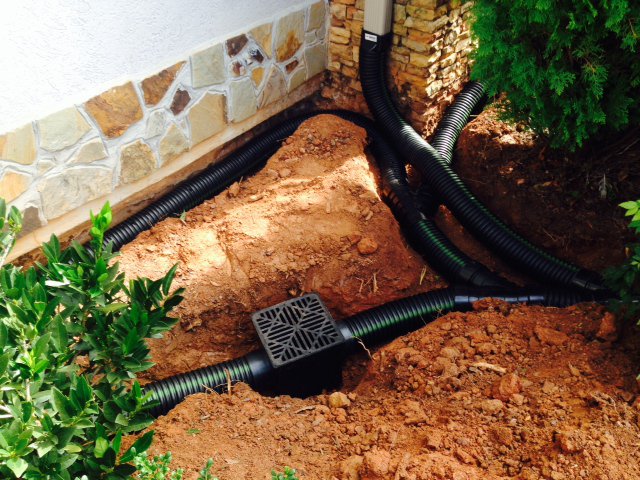
Perforated pipe sits inside the stone. Rigid PVC is easy to clean and durable. Flexible corrugated is cheaper and easier to handle.

Landscape fabric wraps the stone and pipe. It lets water through while blocking sediment, weeds, and roots.

Access: inlets, catch basins, and cleanouts

Inlet grates capture surface surges. Cleanouts let you flush or snake a line during maintenance.

  • Parts you’ll recognize: trench, gravel, pipe, fabric, access points.
  • Install once, do it right: correct slope and materials reduce repeat repairs.

How French Drains Work to Direct Water Away From Your Home

Gravity handles most of the work; our job is to give water a clear path to leave your yard. I explain the mechanics so you can see how a properly built system protects basements and foundations in Metro Atlanta.

Gravity and the path of least resistance

Water follows the easiest route. Compacted Georgia soil resists flow. Coarse gravel creates voids that channel water toward the pipe instead of into your foundation.

Capturing surface water and groundwater

Surface runoff filters through stone and into the trench. Saturated soil around the trench also bleeds into the gravel bed, so both kinds of water are handled.

Perforated pipe orientation and discharge

Perforated pipe holes usually point downward. That lets the trench fill from the bottom and the pipe collect the water that has already entered the gravel.

  • Safe discharge: route to a storm system, curb/street where allowed, rain garden, or cistern—not into a neighbor’s yard.
  • Neighbor-friendly planning: we size slope and outlet so water stays away from your foundation and theirs.
  • Expectation: consistent flow, not just during light rain; outlet and slope are non-negotiable.

Where a French Drain Makes Sense on Your Property

Start with the source: intercepting water before it pushes against your walls is usually the best move. I inspect sites to find obvious flow paths, ponding spots, and low areas that feed the foundation.

Stopping basement seepage: Saturated soil creates hydrostatic pressure that forces water through cracks. A properly placed french drain relieves that pressure by giving water an easier route away from the foundation.
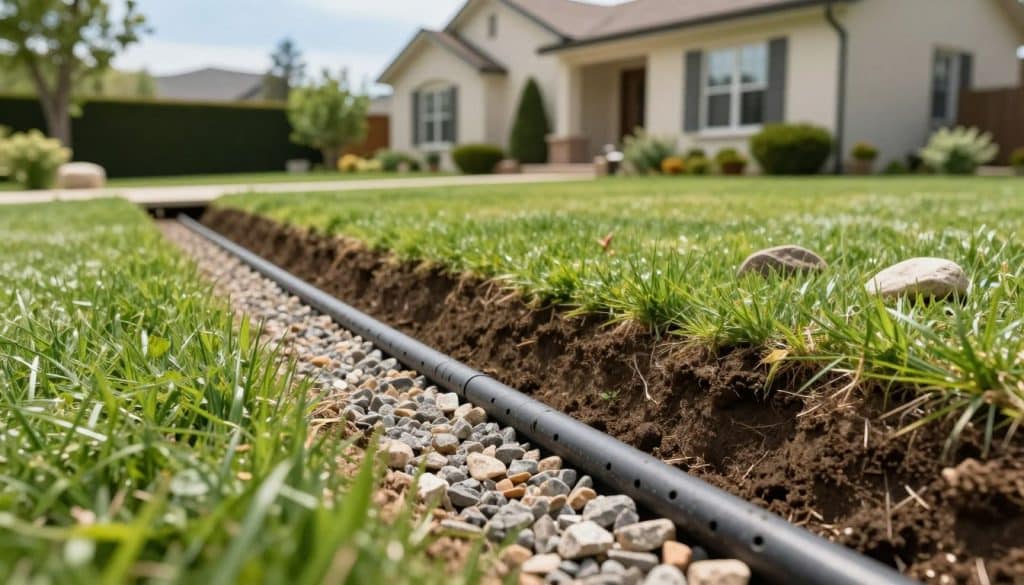
A detailed view of a residential property showcasing a French drain system in action. In the foreground, illustrate the trench of the French drain filled with gravel, with perforated pipes visible. In the middle ground, depict a well-kept lawn sloping gently towards the drain, with vibrant green grass and a few decorative stones scattered around. The background features a charming single-story house framed by trees and shrubs, under clear blue skies. Soft natural lighting illuminates the scene, highlighting the textures of the soil and grass. The overall mood is peaceful and organized, illustrating the practical benefits of effective drainage solutions. Ensure to capture the serenity of a well-drained property without any human figures or extraneous elements.

Fixing standing water after rain

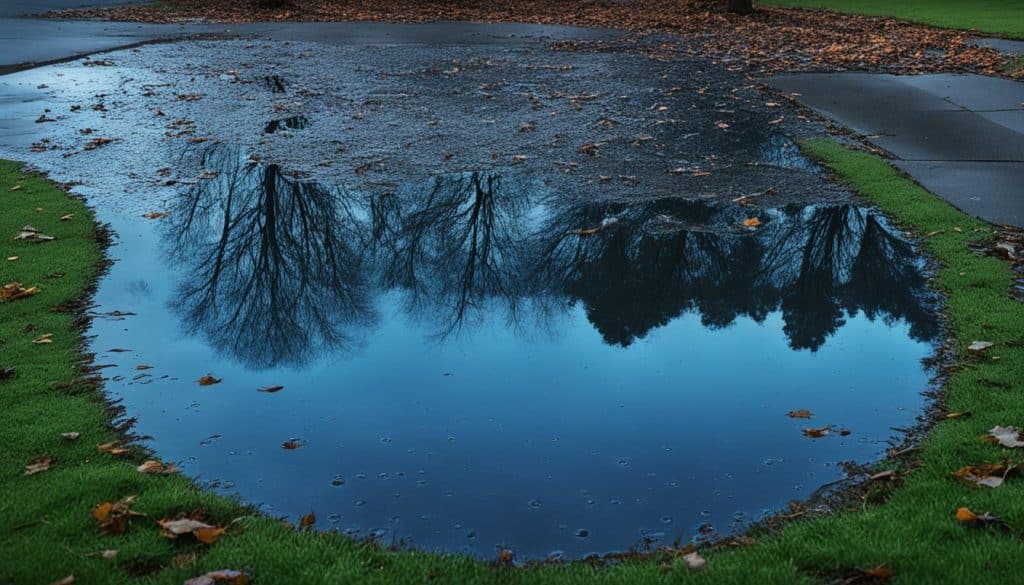
If puddles linger in yard low spots, a surface line or buried drain can move water so the area dries faster and becomes usable again.

Protecting retaining walls

Waterlogged backfill increases lateral pressure and long-term damage risk. Drainage behind or beside retaining walls helps keep soil stable.

Exterior versus interior systems

  • Exterior work targets the cause and is less disruptive to your home.
  • Interior systems with a sump manage water under the slab and usually require cutting concrete.
  • My rule: start with exterior grading and installation when the site allows, then add interior options only if water persists.

Installing French Drain the Right Way: Layout, Trench, and Materials

Before a shovel hits soil, study a rain event to trace where surface and subsurface water actually travel. Watch real runoff to map the true flow path. That step cuts wasted labor and keeps your installation effective.

Plan your outlet first

Confirm where water will leave the property. Tie into a storm drain where allowed, route to a rain garden or cistern, or daylight to a stable low area. Never send water into a neighbor’s yard.

Pitch, trench, and sizing basics

Target a 1–2% slope (about 1″ drop per 8 feet) for reliable water flow. For many installs, dig a trench roughly 12 inches wide and 18–24 inches deep. Wider or deeper runs may be needed near foundations.

Fabric-first and materials

Line the trench with water-permeable fabric and leave ~10 inches of overhang. Add coarse, washed 3/4″ gravel, set the perforated pipe, then wrap the fabric to reduce sediment and roots. A pipeless option uses fabric and gravel only.

Backfill and finish

Finish with visible stone for a dry-creek look, a shallow soil cover for turf, or a mulch strip. Remember: fully concealed lines are neat but harder to service.

If grading or outlet choice is unclear in your Metro Atlanta yard, I’ll evaluate the site and provide a same-day written estimate.

French Drain vs Trench Drain vs Swale: What They Look Like and When to Use Each

Different drainage tools serve different roles; pick the one that fits your site. I’ll show simple visual cues and practical uses so you avoid overspending.

Trench drains show as a long surface grate across paved areas. They intercept runoff quickly on driveways, patios, and pool decks and keep walking surfaces clean. Grates need periodic clearing to maintain flow.

Swales are broad, shallow, grassy channels. They slow surface runoff, reduce erosion, and help water soak in across larger lawn areas. You mow and inspect them for erosion or standing water.

Subsurface systems are for saturated soil and groundwater pressure near foundations. A subsurface line often appears as a rock strip or is hidden under turf. This is the right choice for recurring soggy spots and basement seepage.

  • Quick rule: if you see water moving over the ground, start with surface tools; if soil stays wet or the basement leaks, consider a buried solution.
  • Combined approach: in many Atlanta yards, surface capture feeds a subsurface line so the whole system handles both runoff and groundwater.
  • Maintenance expectations: grates need clearing, swales require mowing and erosion checks, and buried lines benefit from cleanouts and periodic inspection.

French Drain Cost, Time, and DIY vs Hiring a Pro

Budget and site conditions usually set the tone long before the shovel hits soil. I’ll give straight numbers, honest time estimates, and a clear guide on when you should call a pro versus tackling a project yourself.

Typical cost ranges

  • Exterior work: commonly about $10–$50 per linear foot depending on depth, access, and outlet complexity.
  • DIY starts near $1,500 for short runs after rentals and materials are counted.
  • Interior installs often run $40–$100 per linear foot and can reach $10,000–$18,000 when slab cutting and a sump are needed.

DIY realities and practical limits

Digging a trench is hard work. Tools, equipment rental, hauling soil and gravel, and time add up fast.

For many homeowners, about 50 feet is the practical DIY limit. Longer runs, tricky outlets, or deeper foundation work usually justify hiring experienced crews.

When a system isn’t the right choice

A lack of slope or no legal, safe discharge point are real deal-breakers. If water would just pool or flow onto neighboring property, don’t install the trench.

In some cases, a different approach or professional grading prevents more damage and saves money long term.
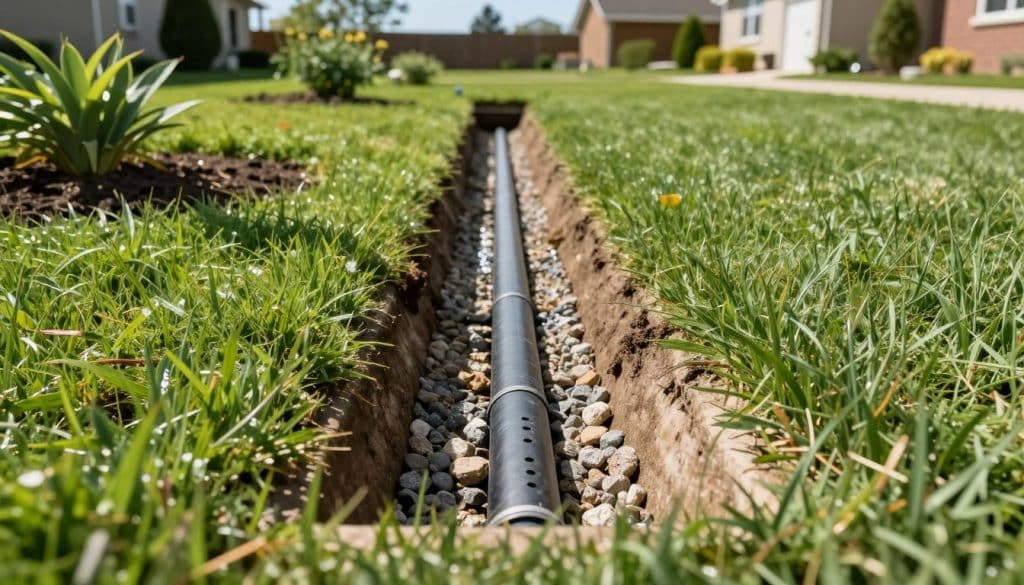
A detailed illustration of a French drain system installed in a residential yard, showcasing its features. In the foreground, depict an open trench filled with gravel and a perforated pipe at the bottom, surrounded by lush green grass. In the middle ground, illustrate the transition from the French drain to the surrounding landscape, highlighting the even drainage of water flowing into the system, with soft soil and plants on either side. The background should feature a serene suburban environment with a well-maintained lawn and a distant view of a house under clear blue skies. Use natural sunlight to create a bright and inviting atmosphere, with a slightly elevated angle to capture the layout of the drainage system effectively. The mood should be informative and professional, emphasizing the practicality of the French drain.

Maintenance and final notes

  • Keep grates clear and watch for sediment in access points.
  • Cleanouts and accessible pipe runs extend service life and reduce future cost.
  • If you prefer a local, no-nonsense plan, we offer same-day written estimates and hands-on service in Metro Atlanta—call (678) 389-9544 or email carter@drainagefirst.com.

Conclusion

A simple, well-placed line of stone and pipe protects your home from recurring water issues. A properly built french drain lasts 20+ years when installed with correct slope, washed stone, and filter fabric.

Use exterior drainage and grading first to ease pressure on the foundation and reduce basement risk. Visible or hidden french drains both give water a safe path away from your house.

Key must-haves: correct slope, clean gravel, proper pipe orientation, fabric, and a legal outlet. Regular maintenance keeps inlets clear and confirms discharge after heavy rain.

If you’re in Metro Atlanta, I’ll give a hands-on look and a same-day written estimate—no hard sell. Call Drainage First at (678) 389-9544 or email carter@drainagefirst.com.
FAQ

Drainage First: What does a French drain look like?

A properly installed French drain is a shallow trench filled with washed gravel that contains a perforated pipe set on a slight slope. The top may be left open as a strip of stone or covered with soil and turf so it blends with landscaping. Exit points, inlet grates, or a visible rock-lined channel at the surface are common clues to its presence.

What does a French drain look like in a yard or around a foundation?

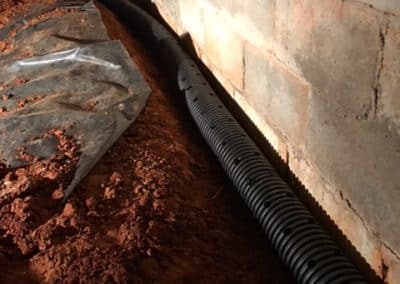
Around a foundation you’ll often see a narrow gravel channel running parallel to the wall, sometimes covered with soil or mulch. In yards it can appear as a rock drainage ditch or a dry creek bed. Inlet grates at ground level, exposed pipe ends at low points, or a buried line under turf are all possible visual signs.

What is the “rock drainage ditch” look and how can it double as hardscaping?

The rock drainage ditch is a shallow, stone-filled swale that guides runoff. It looks intentional and can be dressed with river rock or decorative stone to serve both drainage and landscaping functions—controlling flow while adding a finished feature to the yard.

How can I spot an inlet grate at ground level?

Inlet grates sit flush with the ground and collect surface runoff into the underground pipe. They’re rectangular or circular metal or plastic covers placed at low spots, along driveways, or near downspouts. Look for damp soil or concentrated channels of flow leading to them after rainfall.

How do I find the exposed pipe end or outlet at the bottom of a slope?

The outlet is usually at the lowest point where the system discharges. It may be a short exposed pipe, a riprap apron, or tied into a storm drain. Check downhill edges, gullies, or existing drainage structures for a pipe opening or stone outlet.

What does a concealed French drain look like after it’s covered with soil or turf?

Once covered, a French drain looks like a healthy lawn or filled planting bed. The only signs are improved drainage, less surface pooling, or a subtle linear depression where the trench settled. You might see wetter areas where the system surfaces at outlets.

What does a pipeless French drain look like when built like a dry creek bed?

A pipeless design resembles a natural dry stream—graded channel lined with stone and fabric to move water away without a pipe. It’s wider and more open than a piped trench and doubles as a landscape feature during dry periods.

What are the key parts of a French drain system?

The main parts are the trench, the slope or pitch that directs flow, layers of washed gravel, a perforated drain pipe, landscape fabric to filter sediment and roots, and access features like inlet grates, catch basins, and cleanouts for maintenance.

Why does trench slope matter for water flow?

Slope creates gravity-driven flow. A modest pitch—commonly around 1–2%—keeps water moving through the pipe toward the discharge point. Too little slope causes standing water; too steep can erode the fill or overwhelm downstream outlets.

Why is washed gravel or stone important?

Washed, coarse stone provides void space for water to move quickly into the pipe and reduces clogging. Clean gravel resists fines that would otherwise migrate and seal the drainage path, ensuring long-term function.

What pipe options exist: rigid PVC vs flexible corrugated drain pipe?

Rigid PVC holds shape well and resists crushing; it’s easier to clean with access points. Corrugated flexible pipe is cheaper and simpler to thread through curves but can collapse under heavy loads and trap sediment sooner. Choice depends on load, budget, and access needs.

How does landscape fabric help a French drain?

Fabric lines the trench to separate soil from stone, slowing sediment and root intrusion. A fabric-first approach wraps the gravel and pipe so fine particles can’t migrate into the stone bed and clog the system.

What are inlet grates, catch basins, and cleanouts used for?

Inlet grates capture surface runoff. Catch basins collect debris before it reaches the pipe. Cleanouts provide access for rodding, flushing, or inspecting the pipe. Together they keep the system serviceable and reduce maintenance headaches.

How do French drains direct water away from a home?

They collect surface and shallow groundwater through the gravel bed, funnel it into the perforated pipe, and rely on gravity to move it to a safe discharge point—storm system, swale, rain garden, or daylight outlet—away from foundations and basements.

How do surface water and groundwater enter the system?

Surface runoff flows into inlet grates or the open stone channel. Groundwater seeps through soil into the gravel bed, where it follows the path of least resistance into the perforated pipe and out to the chosen outlet.

Why are perforated pipe holes typically oriented downward?

Downward-facing perforations keep sediment out and allow water drawn from the saturated soil below the pipe to enter more easily, improving flow and reducing the chance of debris clogging the openings at the top.

Where should the water discharge safely?

Discharge should go to a municipal storm drain, a permitted swale, a rain garden, a cistern, or a daylighted outlet on your property that won’t flood neighbors or cause erosion. Planning a reliable outlet is critical before you dig.

Where does a French drain make sense on a property?

Use it to relieve hydrostatic pressure at foundations and stop basement seepage, drain standing water and soggy lawn areas, protect retaining walls from saturated soil, or route roof and yard runoff to a safe outlet.

How does an exterior French drain compare to interior systems with a sump pump?

Exterior drains intercept water before it reaches the foundation and reduce hydrostatic pressure. Interior systems collect water that has already entered and pump it out. Exterior solutions prevent some interior problems but aren’t always feasible in tight or flat sites.

How should I plan layout, trench, and materials before installing?

Watch rainfall patterns to map flow paths, confirm a discharge location, plan the slope (about 1–2%), size the trench (commonly 12″ wide and 18–24″ deep), use fabric-first wrapping, choose coarse washed gravel, and provide cleanouts and proper connections to the outlet.

What practical trench sizing and pitch guidelines should I follow?

A typical residential trench is roughly 12 inches wide and 18–24 inches deep. Aim for a 1–2% pitch (1–2 feet of drop per 100 feet) to keep water moving without causing erosion.

Why is a fabric-first approach recommended?

Wrapping the gravel and pipe in landscape fabric keeps soil and roots from infiltrating the stone bed, which preserves flow capacity and reduces long-term maintenance needs.

How do I choose the right gravel size?

Use coarse, washed stone—typically 3/4″ to 1-1/2″ angular rock. Clean gravel maintains voids for flow and resists clogging. Avoid fine or rounded river sand that packs and restricts movement.

What are backfilling and finish options that blend with landscaping?

After backfilling, finish with topsoil and sod, decorative stone, mulch, or a planted strip. A dry creek bed or planting border can conceal the system while still allowing function and access at cleanouts.

How do French drains differ visually from trench drains and swales?

Trench drains are surface channels with long metal grates over paved areas. Swales are broad, shallow, grassy channels that slow runoff. French drains are narrower, stone-filled trenches that work below the surface to move water away.

When should I use a trench drain or a swale instead of a subsurface system?

Use a trench drain for concentrated runoff across hard surfaces like driveways. Use a swale to slow and filter sheet flow across open land. Use a subsurface French drain when the problem is saturated soil or foundation seepage.

What are typical cost ranges and timeframes for French drain projects?

Costs vary with length, depth, access, and outlet work. Small DIY jobs may be low-cost, while professional installs for foundation protection run higher per linear foot. A simple residential run can take a day or two; larger systems take longer and often require equipment.

What should I expect if I try a DIY French drain?

DIY requires trenching tools or a trencher, time, and proper slope control. Long runs, rocky soil, or ties to storm systems complicate work. Many homeowners find 50 feet a practical DIY limit before hiring a pro.

When isn’t a French drain the right choice?

If there’s no slope or no legal place to discharge, if subsurface rock prevents trenching, or if the problem is large-scale groundwater requiring engineered solutions, a French drain may not be appropriate. In those cases, alternatives or professional drainage design are needed.

Best Solutions

We have experience with a wide range of water issues.

See our Work

View our amazing drainage transformations.

Free Estimate

Contact us today to schedule a free consultation.

Services We Offer

What Our Customers Are Saying

Customer satisfaction is at the heart of everything we do. But don’t just take our word for it – hear what some of our happy clients have to say:

Drainage First - About Us - Contact Us

Call us now for your free estimate
24/7 Service Available

Share:

Learn More, Check Out

Send Us a Message